Our Avos' names were carved in stone. Their Yom Tov observances were written on papyrus. Their botei tefillah and botei avodah were described in letters that survived thousands of years in the Egyptian desert. These are those ksavim.
The Merneptah Stele (The "Yisroel Stele")
c. year 2556 📍 Egyptian Museum, Cairo. Found at Thebes, 5656A three-meter-tall black granite monument carved in the fifth year of Pharaoh Merneptah, mainly about his military victories. But in the last few lines, the inscription turns to a campaign in Eretz Canaan, and right there, carved by a Mitzri scribe over three thousand years ago, is the name of our nation.

Among the lines: "Israel is laid waste, bare of seed." The way it's written is telling. The other names (Ashkelon, Gezer, Yanoam) are marked in the hieroglyphs as cities, but "Yisroel" is marked as a nation. The Mitzri scribes recognized Yisroel not as a place but as a distinct nation living in Eretz Canaan.

The Elephantine "Pesach Papyrus"
c. years 3342–3343 📍 Egyptian Museum, Berlin. Found on Elephantine Island, 5667On a tiny island in the Nile near Aswan, at the southern border of Mitzrayim, a kehillah of Yiddishe soldiers served in the Persian military garrison during the 3200s–3300s. They built a beis avodah to Hashem, kept Yiddishe minhagim, and wrote to their brethren in Yerushalayim and Shomron.
The most well-known document from this kehillah is the so-called "Pesach Papyrus," a torn-up letter sent by a man named Chananyah to Yedanyah, the leader of the kehillah. Despite the damage, what survives matches the observance of Chag HaMatzos almost exactly: counting from the 14th of Nissan, eating matzos for seven days through the 21st, not doing melachah, not eating anything chometzdig, and locking away chometz during the Yom Tov.

The Elephantine Beis Avodah Correspondence
c. years 3351–3354 📍 Various museums. Found on Elephantine IslandIn the year 3351, the Yiddishe beis avodah on Elephantine was destroyed by Mitzri galachim of the local avodah zarah Khnum, who were furious that the Yidden were shechting sheep and rams, since those animals were sacred to Khnum. The kehillah's Kohen, Yedanyah, wrote to Bagoas, the Persian governor of Yehudah, and to the sons of Sanballat, governor of Shomron, asking for help rebuilding their beis avodah.
The "Petition to Bagoas" (year 3354) is one of the most significant ksavim from the ancient Yiddishe world. It describes the destroyed beis avodah in detail: cedar roofing, five stone gateways, gold and silver keilim, and a functioning avodas hakorbanos. The correspondence shows a Yiddishe kehillah deeply connected to their mesorah despite living hundreds of miles from Yerushalayim.
The Arad Ostraca & "Beis Hashem" Inscription
c. year 3161 📍 Israel Museum, Yerushalayim. Found at Tel Arad, 5720sTel Arad, a Yehudi fortress near Be'er Sheva, turned up a collection of over 200 inscribed pottery sherds (ostraca) written in ksav ivri. Most of them are military correspondence: supply orders, troop movements, records sent to the fort's quartermaster, Elyashiv.

One ostracon mentions "Beis Hashem" (בית ה׳), which is widely understood as a reference to the Beis HaMikdash in Yerushalayim. It is one of the only references outside of Tanach to a pre-galus Beis Hashem. The ostraca also mention mishpachos of Kohanim (mishpachas Keros, referenced in Ezra 2:44) and names like Meremos and Pashchur that appear in Sefer Nechemia.
A 5780 handwriting study showed that the Arad ostraca were written by at least twelve different people. Since the whole garrison was probably only 20–30 soldiers, that means a very high percentage of them could read and write. Some have suggested this could mean that significant parts of Tanach were already being written during this tekufah.
The Tel Arad Beis Avodah
c. years 2811–3061 📍 Tel Arad National Park, Eretz Yisroel. Replica at the Israel MuseumThe Arad fortress also had the only beis avodah from malchus yisrael ever properly dug up in a planned excavation. It was built on the same plan as the Mishkan described in the Torah, with a chatzer, a heichal, and a kodesh hakodashim reached by going up three steps.

In the kodesh hakodashim they found two mizb'chos haketores and matzeivos, with burnt ketores residue still on the tops of the mizb'chos. In the chatzer, a square mizbe'ach built of small, unchiseled stones, exactly matching the Torah's issur against using metal-hewn stones for a mizbe'ach (Shemos 20:22). The dimensions match the five-amah-square specification in Shemos 27:1.
The beis avodah was apparently taken apart during the reforms of Chizkiyahu or Yoshiyahu HaMelech, who centralized the avodah in Yerushalayim. The careful way it was taken apart, with the keilim laid on their sides and covered over, suggests it was closed down with kavod, consistent with centralizing korbanos at the Beis HaMikdash rather than destroying a makom kadosh.
The Beis HaMikdash Warning Inscriptions
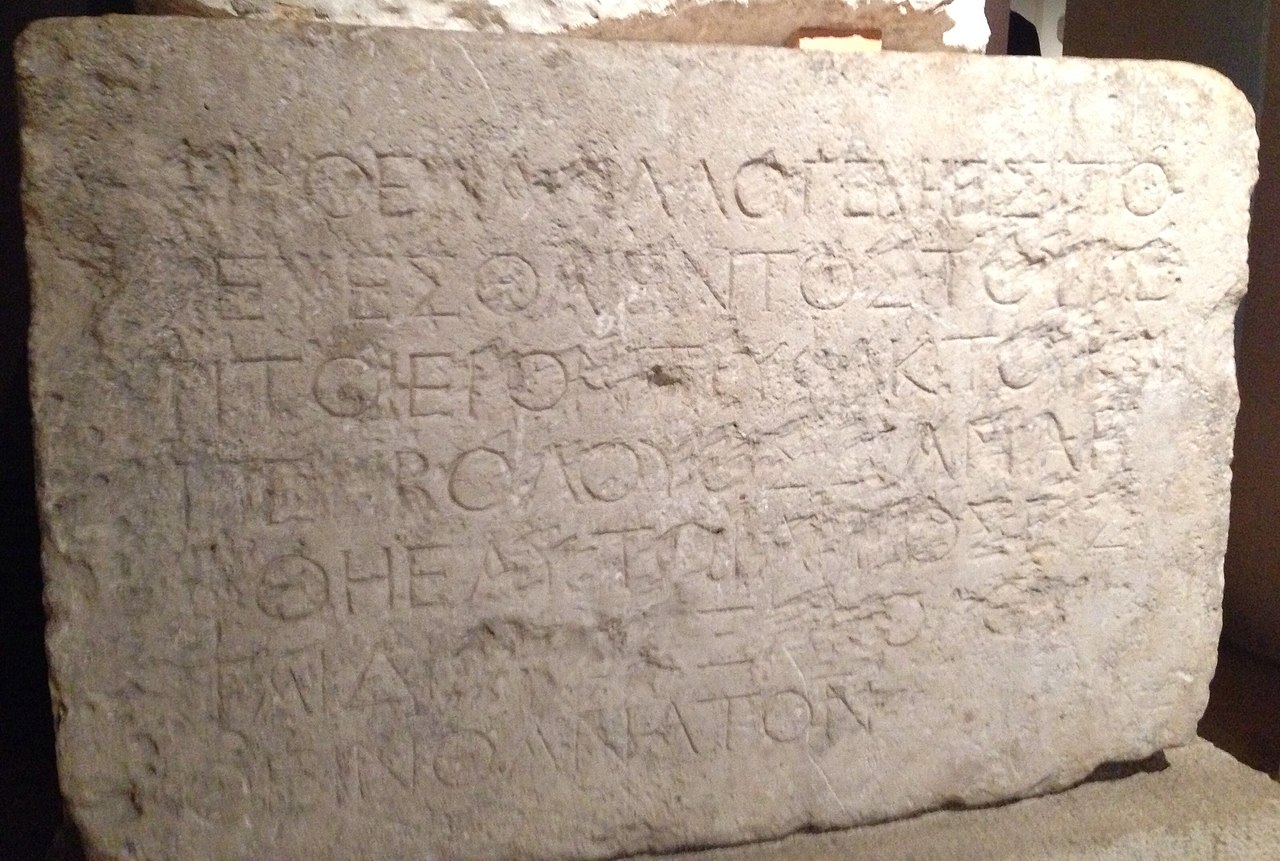
Late 3700s – early 3800s 📍 Istanbul Museum of Archaeology; Israel Museum, YerushalayimTwo stone inscriptions in Greek were set up at the soreg, in the Beis HaMikdash, the low wall separating the area that non-Jews could not cross. The full inscription reads (in translation): "No foreigner shall enter within the balustrade and enclosure around the Temple. Whoever is caught will have himself to blame for his ensuing death."